A participant in the Boston Tea Party has received new recognition in New Hampshire more than 250 years after the historic protest helped set the stage for the American Revolution.
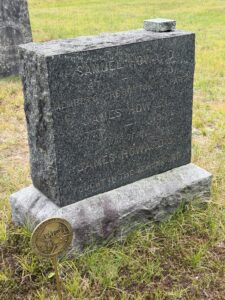
A commemorative grave marker honoring Samuel Howard was presented Tuesday, August 18, at Center Conway Cemetery in Conway. The ceremony was organized by the Boston Tea Party Ships & Museum in partnership with Revolution 250 and the Conway Historical Society.
Howard is the third confirmed Boston Tea Party participant buried in New Hampshire to receive a marker through the museum’s ongoing initiative to recognize the final resting places of those who took part in the December 16, 1773 protest.
Samuel Howard’s Connection to the Boston Tea Party
Howard was born on May 2, 1747, and was working as a ship’s caulker in Boston at the time of the Boston Tea Party in 1773.

A closeup look of Howard’s Grave Marker. Boston Tea Party Ships & Museum, 2026.
According to information provided by the Boston Tea Party Ships & Museum, Howard later recalled gathering with other young men at a cabinet-maker’s shop on the evening of December 16, 1773. After disguising themselves, the group reportedly sought advice from several influential men in Boston before deciding to proceed to Griffin’s Wharf.
Howard’s account of his involvement was later published in the August 1845 issue of the Yale Literary Magazine.
Historian Benjamin L. Carp’s book Defiance of the Patriots also connects Howard to a broader network of people who participated in the Boston Tea Party. According to the museum, Howard had professional and community ties to other future participants in the years leading up to the protest.
Howard Later Served in the Revolutionary War
Howard’s involvement in the Revolutionary era continued after the Boston Tea Party.
According to the museum, he enlisted in 1776 and served as a private under Captain Edward Burbank in Colonel Henry Knox’s regiment. Howard took part in the Battles of Trenton and Princeton in New Jersey during the Revolutionary War.
Following the war, Howard and his family relocated to the New Hampshire and Maine border region, eventually settling in the Conway area. He married Mary Haley, and the couple had three children.
Howard died in Conway on June 1, 1840. He is buried at Center Conway Cemetery on East Main Street, where his commemorative marker was presented last week.
Conway Ceremony Recognizes Howard’s Place in History
Tuesday’s ceremony included representatives from several local and regional historical organizations.
Participants included Conway Historical Society President Ken Rancourt, Vice President Brian Wiggin, and Executive Director Heather Corrigan, along with members of the Conway Historic District Commission.
Representatives from the Boston Tea Party Ships & Museum included Creative Manager Evan O’Brien and Kristin Harris, research coordinator for the Boston Tea Party Descendants Program. Jonathan Lane, executive director of Revolution 250, also participated in the event.
Howards important place in history will be forever remembered. Boston Tea Party Ships & Museum, 2026.
As part of the ceremony, a commemorative plaque honoring Howard was presented at his gravesite.
The marker features imagery inspired by Nathaniel Currier’s 1846 lithograph The Destruction of Tea at Boston Harbor, one of the best-known artistic depictions of the Boston Tea Party. The marker is intended to remain at the gravesite indefinitely.
Third Boston Tea Party Marker Placed in New Hampshire
Howard joins two other Boston Tea Party participants buried in New Hampshire who have received commemorative markers through the initiative.
A marker honoring Ebenezer Mackintosh was placed at Horse Meadow Cemetery in Haverhill on July 16, 2022. The following day, a marker recognizing Samuel Nowell was placed at Lakeview Cemetery in Wolfeboro.
The Boston Tea Party Ships & Museum began its grave marker initiative in 2018 with the goal of recognizing known participants in the historic protest.
Since then, more than 120 commemorative markers have been placed at gravesites in the United States and abroad. Markers can be found in cemeteries across Connecticut, Indiana, Maine, Massachusetts, Michigan, New Hampshire, New York, Ohio, Rhode Island, and Vermont, as well as in Kilkenny, Ireland, and Paris, France.
The project is connected to the museum’s Boston Tea Party Descendants Program, which works with American Ancestors to research genealogical connections to Boston Tea Party participants and their families.
Howard’s recognition in Conway comes as communities and historical organizations across the country commemorate the 250th anniversary of American independence and revisit the people and events that shaped the American Revolution.